Friday, September 6, 2013

Social & Political Aspects of Water Crisis in Pakistan: Post # 22

1. Management of Population Dimension

Population Management as a Way-out for Stopping Drop in Water Availability per capita: It is interesting to note that everyone in Pakistan is concerned about the downward slide in water availability, but we hardly ever mention the major cause of the steep drop in annual water availability per person from 5300 m3 in 1950-53 to under the water scarcity marker of 1000 m3 presently—that is, population explosion. In order to obtain a realistic appreciation of the water crisis we face, we need to acknowledge the importance of the effect of the population hike from 34 million in 1953 to 176 million in 2010.

This increase in demand is also evident in the fact that irrigated land has increased from 9.23 million hectare in 1950-53 to 18.02 million hectares in 2000-03, which is an increase of almost 100 percent. However, our surface water diversions to the irrigated lands only increased from 83.4 BCM (67.64 MAF) to 129.4 BCM (104.95 MAF) during the same period. Since this increase in water availability was less than the additional area brought under irrigation, annual water delivery depth per unit area actually dropped from 0.90 m to 0.72 m—these figures are significantly lower than the required irrigation depths for each province, as illustrated in Table 3. With the use of tube-well technology introduced in the 1960’s, additional groundwater availability of about 50.29 BCM (40.8 MAF) has brought the current annual water depth to 1.0 m, which is only slightly higher than before. Hence, even with the additional groundwater resources, we do not have an adequate amount of water supply and are forced to live with a deficit irrigation phenomenon in this country. It is no wonder that our productivity in many crops is well below that found on the Indian side of the Indus Basin.

Based on the data presented above, it appears that the main cause of the steep drop in per capita water availability has less to do with the quantity of water available and more to do with the ongoing population explosion in Pakistan. Unless we come up with measures to manage this explosion, there is no way to check this free fall in the annual water availability per capita.

2. Additional Confidence Building Measures regarding Indus Water Treaty: 

Why do we need additional measures to implement the Indus Water Treaty when there are already institutional provisions in the form of the Indus Water Commission and a built-in mechanism for a neutral arbitrator that can be sought through the World Bank? One obvious answer is that the existing provisions have not helped to fully remove the mistrust developed between our upper and lower riparian states. The main reason for this mistrust is that most Pakistanis have come to believe that the existing mechanisms are not sufficient and additional confidence building measures are needed to ensure that the treaty is followed in its true letter and spirit. In order to address this mistrust, Indian journalist Sandeep Dikshit reports that the Government of Pakistan has proposed the following steps (the Hindu, 12th March 2010):

  1. Construction of projects at three western rivers should be undertaken only after objections are amicably resolved;
  2. Joint watershed management should be agreed upon;
  3. Joint commission of environmental studies be established;
  4. India should provide details of any new project six months before commencement;
  5. Diversions for storage and farm purposes should be conveyed to Pakistan; and
  6. India should also provide details about ancillary projects.
In response, India has expressed its concerns, as per the referred report:
  1. Pakistan needs to improve water management , and
  2. The drop in flow is because of overall pattern of receding glaciers.
Regarding the first point from the Indian side, water management improvements have been Pakistan’s main focus for the last four decades or so. However, there is a lot of room for improvement and any good suggestions in this area should be seriously considered, such as a greater focus on watershed management. India’s second point further highlights the need for Pakistan’s proposal of a joint commission for conducting environmental studies. If glaciers are receding, they must be receding due to excessive melting—therefore, it does not in itself explain the current drop in water flow in the rivers entering Pakistan. Hence, it makes sense to improve trust between the two states by jointly conducting such environmental studies to let scientific data support or reject such ongoing arguments.

Dikshit’s report also states Pakistani concerns about deforestation and water pollution on the Indian side of Pakistan’s rivers. Furthermore, Pakistani officials often have complaints regarding Indian non-responsiveness to their concerns raised in the Indus Water Commission.
In the given context, if both countries wish to follow the Indus Water treaty of 1960 in its true letter and spirit, they must whole heartedly support this proposition of adding necessary confidence building measures to ensure transparent, honest and fair water transactions as agreed upon in the treaty. 

Demanding a renegotiation of this treaty would be tantamount to opening Pandora’s box and would likely become too difficult to manage. We must remember that it took India and Pakistan more than 12 years to strike a deal; it is hence better for regional peace and security if our emphasis remains on demanding potential confidence building measures to ensure its proper implementation. If rationality prevails on both sides, this is a doable option whereas the alternative of revisiting or reinventing this treaty would be too dangerous for both states to even contemplate.

After the most recent (March 2010) meeting of the Indus Basin Commission in Lahore, the Pakistani representative has hinted on an agreement to install a telemetry system to monitor water levels at different points along the western rivers of the Indus Basin. At this time, details of such an agreement have not been made public; nevertheless, this is an important and encouraging development. However, it remains to be seen if both parties have also agreed to jointly operate and maintain this monitoring technology or if they plan to hire a third party to operate and manage this appreciable confidence building measure. It goes without saying that if a fool-proof arrangement is not agreed upon for the operation and management of such a system, mere installation of such devices will turn out to be only a window-dressing gimmick. Both parties should review the failure of the telemetry system previously installed in Pakistan and Egypt for flow monitoring and then decide upon a mutually satisfactory arrangement to make such a technology based CBM work.

The remaining three western rivers of the Indus Basin are virtual life-lines for Pakistan and its people. As both Pakistan and India are nuclear states, any threat to the survival of one can seed destruction all around. Hence, this water issue has a real potential for turning this beautiful sub-continent into Hiroshima and Nagasaki. Neither of these countries can rationally contemplate the emergence of such a scenario. Therefore, if India and Pakistan wish to implement the Indus Water Treaty in its original letter and spirit, they both should remain focused on adding mutually verifiable CBMs to eliminate all sources of distrust on trans-boundary water management.

If there is no hidden agenda to hurt each other, let us also consider stationing representatives from Pakistan at each dam site and control point as Egypt, being a lower riparian country itself, has been allowed to do for monitoring purposes. Without such institutional arrangements in place, even a telemetry system will not deliver desired results.
Of course, whereas Egypt, while being the lower riparian of the Nile River, is a dominating regional power, Pakistan does not enjoy such a status. In the South Asian sub-continent, India is the dominating regional power as well as a non-friendly upper riparian state. This presents a doubly uneven playing field for Pakistan. All cards are virtually in the Indian hands and it is playing these cards blatantly.

By allowing India to have sluice gates for the removal of silt in the Baglihar case, the “neutral arbitrator” has set a devastating precedent without assigning pre-conditions to safe guard the original spirit of the treaty to ensure proper water quantity and proper timing. For example, the recent filling of the Baglihar Dam occurred when the river flow was too low and it was a critical time for planting crops in Pakistan. It does not require rocket-science to foresee what the other dozens of planned dams in India can do to Pakistan since its main economy is agriculture.

Needless to say, water is not an ordinary issue for Pakistan. Its rivers are the lifeline for its survival and its existence depends upon the implementation of the Indus Water Treaty not only in letter, but in spirit. Obviously Pakistan would like this treaty to address all possible hindrances and potential manipulations in terms of quantity and timing of all allocated flows from the three western rivers to its territory.

In such a scenario, there is a real potential for things getting out of control for both nuclear states. People from both sides have to realize the potential dangers and force their decision-makers to stop playing games with the survival of more than one billion people of India and Pakistan and start devising solid confidence building measures to calm this emotive and combustible situation. As Professor John Briscoe cautions, India is in the driver’s seat, and it has all the levers of control to avoid a train-wreck on the Indus.

3. Additional Confidence Building Measures for Implementing Water Apportionment Accord of 1991: 

What a strange irony of fate that the measures that Pakistan demands from India as a lower riparian state, its provinces are hesitant to practice in domestic water distribution. The Accord of 1991 actually provides a unique opportunity and challenges all domestic stakeholders to demonstrate that they are capable of thinking creatively about new and effective confidence building measures on their own. For the next step, they should be courageous enough to plan and implement all such new confidence building measures to eliminate fears and reservations regarding water distribution among the four units of Pakistan and to finally end the ongoing blame game against each other.

At the domestic level, Punjab is the relevant upper riparian region for Sindh and is the relatively dominant province of Pakistan. As such, it replaces India in the local context as the power in the driver’s seat of the water train, with most of the controls in its hands. Here is the litmus test for Punjab to set a good example by avoiding the “train wreck”. What Professor John Roscoe proposed to India as a upper riparian state when explaining Pakistan’s feelings, I can apply the same here with appropriate alterations, to the people of Punjab—that there must be some courageous and open-minded Punjabis – whether in the government or out – who will stand up and explain to the public why water is not just an issue for Sind, but why it is an existential issue for Sind. A similar statement goes for the people of Sind in the context of their role as an upper riparian region for some parts of Baluchistan. Perhaps this can help create an environment conducive for rational discussion among all concerned.

To be fair to all the stakeholders in Pakistan, water is equally a matter of existential issue for Punjab as well. As a matter of fact, this desperation for water that we see in all concerned stakeholders in Pakistan could be considered a positive factor as it should facilitate their ability to empathize with the concerns and reactions of the lower riparian regions. However, history does not support this optimism. Instead, narrow but emotional, self-serving alternatives are being cashed in to promote parochialism for political gains. Not surprisingly then, such self-destructive politicization of technical issues of water acquisition and distribution has been no help in facing the water crisis. Moreover, if we continue to follow this same irrational path in the future, we will be playing into the hands of those people who wish that Pakistan, the California of Asia, is converted into the Somalia of Africa. If that happens, we will not be able to blame it all on outside elements, as we keep on avoiding to accept emerging challenges and responsibilities to avert such a crisis.

As stated earlier, the Water Apportionment Accord of 1991 was a great achievement in securing consensus among four provinces of Pakistan where discord is a common phenomenon but accord is an almost unheard commodity. This accord was based on brute give and take arrangements, and hence, this consensus based agreement must be adhered to and strengthened as a way out to plan and implement water projects as per allocated water resources for each province.

On one hand, there are people in Sindh who cry foul over this agreement and claim that Punjab took undue share of Indus water under this agreement. On the other hand people in Punjab have their own grievances. For many Punjabis, water should be distributed in the Indus Valley equitably based on area irrigated as per accepted and implemented principles of basic design in an irrigation system; thus, is it fair that when Punjab has 75.5% of the total irrigated area of Pakistan in 1990-1993, it should only get 47.67% of total water allocation? This causes severe heart-burn when Punjabis see that Sindh has only 15.5% of total irrigated area in Pakistan at the time of this Accord, yet it received 41.55% of total water allocation from the Indus River System. In their view, as the agricultural sector uses 97% of the total water available in Pakistan, this operational rule should have been followed instead of historic claims that lost relevance with the establishment of modern weir-controlled canals designed for equitable water distribution based on irrigated area (replacing the outdated inundation canals). A fair agreement would have been one where 97% of the water allocation (the portion of total water usage attributed to agriculture) was equitably based on irrigated area and the remaining 3% of total water available to Pakistan was distributed on a population basis.

Nevertheless, as Punjab signed this Accord, as law abiding people of Pakistan, the above exercise in what should have been serves only to demonstrate the extent of compromise and sacrifice made by the majority group for a the minority group of one country—there is no question of second thoughts to unsettle an issue that has already been settled through consensus. As a matter of fact, we should remind ourselves that a consensus building process always requires some give and take and politically sharp people usually extract the maximum benefit.

For Sindh, achieving consensus to secure more than their fair share in the emerging scenario of severe water scarcity is a monumental success. At present, rather than crying foul so that they can claim more, it would be more productive for them if they invest their extra efforts for devising and implementing credible confidence building measures to ensure that their share of water is distributed as per the Accord of 1991.
Similarly, Baluchistan should be given the same right to have all such CBMs put in place in Sindh so as to ensure they are provided with their agreed upon share—just as Sindh would wish to have such measures to get its due share from Punjab and Khyber-Pakhtunkhwa. Some arrangements are already put in place but either they are not very effective or their functionality is questionable.

For example, as informed by a former irrigation secretary of Punjab, Sindh has its representatives appointed at critical control points of the Indus River System to monitor actual water distribution as it happens. I am sure that such an arrangement must have been on a reciprocal basis. My proposal will be that we spend less time criticizing a well-intended arrangement but invest more time and effort in finding the root causes of potential discord and suggesting additional adjustments or changes to make the existing arrangement a well-functioning CBM.

Then there is the expensive telemetry system that has been installed to provide real time flow data at critical control points along the Indus River System. The only thing functional in this context is the ongoing blame game and not the telemetry system itself. Why did all this investment go to waste without producing the intended positive results? No neutral or local entity has been made to study the failure of this excellent real-time monitoring system. My proposal would be that we set up a time-bound independent judicial commission or ask the International Water Management Institute to study the real causes of failure and suggest ways and means to make it work as per the satisfaction of all stakeholders.

The Indus River System Authority (IRSA), is itself an excellent CBM between beneficiaries as far as this arrangement for water distribution is concerned. As compared to the Indus Water Commission, IRSA is much more effective in allocating water among all four contending provinces. In order to address complaints from Sindh, Musharaf put a Sindh based federal representative in addition to the four members from all four provinces for IRSA. In Punjab, such arrangements is perceived to be unfair as it is the province that produces almost 80% of the granary in Pakistan but the referred change further reduced its corresponding role and say in water distribution at national level.

For any arrangement to succeed and be sustainable, it has to be fair for all. In this context, a third party should be hired to study the weaknesses of IRSA and propose measures that make this body a fair institution instead of a kind of inter-provincial semi-political game club where all dice are loaded against only one province. As the cliché goes, only fair games produce fair results; let us ensure a fair and honest game for the sake of all concerned once and for all. If we wish to have non-controversial institutions, let more honest and transparent efforts be invested in making IRSA itself a confidence building measure for all four provinces.

In view of the disharmony and discontent over water distribution, we have a long way to go putting in all transparent and effective safe-guards in place before getting a satisfactory and functional system at the national level. If we manage to do so, our success at home will provide us with a precedent that can then be used to demand similar workable measures at the regional level under the Indus Water Treaty. In other words, if we cannot be fair and transparent in our dealing with our domestic water issues, how can we demand a fair and transparent implementation of the Treaty from a not-so-friendly upper riparian and regional power that holds all the cards in the given context?

Wednesday, September 4, 2013

Nature of Water Crisis: Post # 21


A.   Nature of Water Crisis: 

Water crisis is a term that refers to the scarcity and quality of available water resources relative to human demand. The nature of water crisis is such that it can change from one context to the next. Observation of the following indicators signify a global water crisis (Wikipedia)[1]:

  • Inadequate access to drinking water for 1.1 billion people;
  • Inadequate access to water for sanitation and wastewater disposal for 2.5 billion people;
  • Groundwater excessive use leading diminished agricultural yields;
  • Overuse and pollution of water resources harming biodiversity; and
  • Regional conflict over scarce water resources sometime resulting into warfare.
In order to standardize comparison between regions, an international indicator measuring the quantity of water available per year per person has been established to determine the emerging seriousness of the water crisis. A region is said to be water stressed if the per capita annual water availability ranges between 1000-2000 m3. The locality is facing a water scarcity situation if the amount of water drops below 1000 m3.

There are significant distortions found in the distribution of water across the globe (Amin Dadbhoy, 2003)[2]. On the one hand we find regions like Kuwait, Ghaza and UAE that experience water scarcity with annual per capita water availability averaging around 10 m3, 52 m3 and 58 m3, respectively. At the other extreme, there are regions abundant in water—for example, French Guiana (812,121 m3), Iceland (609, 319 m3), Guyana (316,689 m3), Surinam (292, 566 m3), Congo (275,679, m3), Canada (94,353 m3) and New Zealand (86,554 m3).

These wide disparities of water availability are a result of the geography and climate of the regions. With the oncoming climatic changes, humid regions are expected to receive even more rain and arid and semi-arid zones are predicted to see lesser and more erratic rainfall. According to one estimate, climatic change may lead to an additional 20% scarcity in water in drought-prone areas (M. Amin Dadabhoy, 2003)[3]. Hence, due to population growth and changes in the climate, the water crisis in non-humid regions will be exacerbated.

In the case of Pakistan, its water crisis is a complex and multi-faceted phenomenon. Whereas in 1951 Pakistan’s per capita water availability was 5,300 m3, it is now expected to drop to 850 m3 by 2013. This trend is mainly due to the jump in population from 34 million in 1951 to the projected 207 million in 2013. A six factor increase in population in 62 years has obvious ramifications for per capita water availability. The outcome is presented in Table 1[4].
Table 1:  Past, present and future water availability per capita per year in Pakistan
Year
Population (million)
Per capita Availability (m3)
1951
34
5300
1961
46
3950
1971
65
2700
1981
84
2100
1991
115
1600
2000
148
1200
2013
207
850
2025
267
659
Source: Draft State of Environment Report 2005

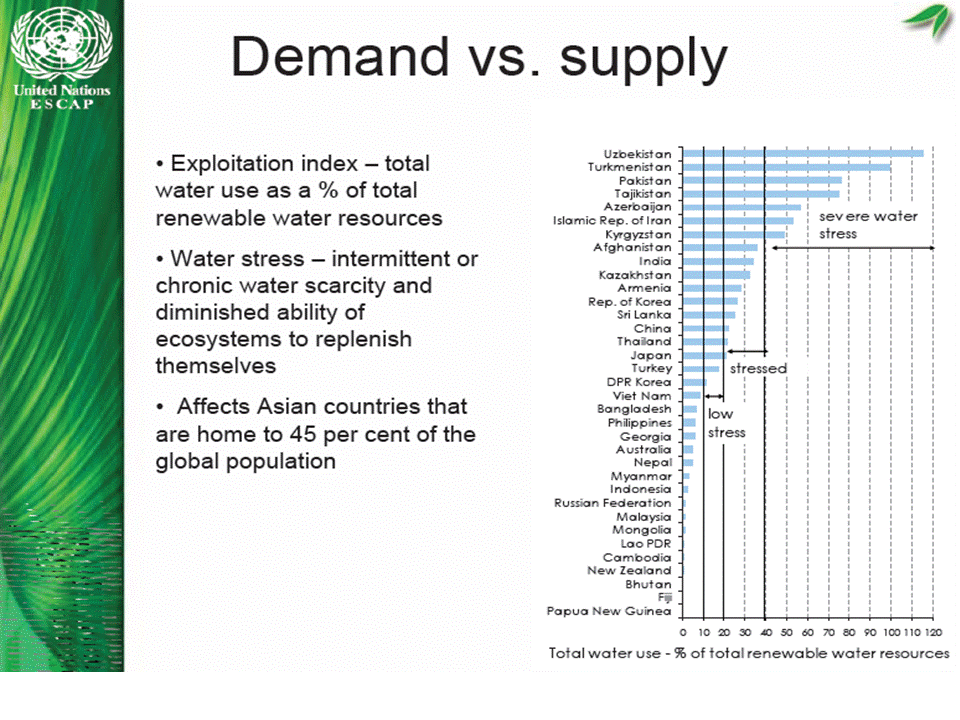
Pakistan’s current water scarcity becomes an even greater concern when we look at the degree of control over water sources and the percentage of renewable water usage. These indicators put additional stress that is over and above of the already identified level of water stress or scarcity in the country. As presented in Figure 1[5], 75% or more of Pakistan’s accessible surface water originates from outside its borders from Indian controlled territory. Considering the political hostility between the two states, this dependence on an outside source leaves Pakistan even more vulnerable.  Pakistan’s case is further exacerbated when observing[6] that its use of water as percentage of total renewable surface water resources is more than 75% (Figure 2). This high rank in the water exploitation index places Pakistan as a severely water stressed country.

Figure 1. 


Figure 2.


Besides establishing water stress through the water availability per capita per year indicator, there is also a need for an additional indicator that can capture the irrigation water requirements and availability in countries where the agricultural sector predominates in water consumption.  In the South Asian sub-continent, the agricultural sectors of Nepal, Pakistan, India and Bangladesh use 99%, 97%, 92% and 86% of total water available, respectively. Thus, in order to obtain a better representation of whether water supply meets demand, it is perhaps best to supplement the existing criteria of judging water scarcity with others for a fuller picture of the causes of the prevailing water crisis in the region.
Table 2.  Historical Canal Water Diversions in the Indus Basin of Pakistan[7]
Key Influences
Period
Canal Diversions MAF / (billion m3)
Kharif
Rabi
Annual
Pre – Partition
1940-1947
47.6/ (58.5)
20.2/ (24.9)
67.8/ (83.4)
Partition
1947-1948
46.3/ (57.0)
22.4/ (27.6)
68.8/ (84.6)
Dispute
1948-1960
51.5/ (63.4)
24.7/ (30.4)
76.3/ (93.8)
Pre – Mangla
1960-1967
60.3/ (74.2)
27.6/ (34.0)
88.0 / (108.2)
Post – Mangla
1967-1975
65.3/ (80.3)
30.2 (37.1)
95.5 (117.4)
Post – Tarbela
1975-1980
68.1/ (83.7)
38.2/ (47.0)
106.3 / (130.7)
Post – Tarbela
1980-1985
68.4/ (84.1)
37.3/ (45.9)
105.7 (130.0)
Post – Tarbela
1985-1990
66.3/ (81.6)
37.7/ (46.4)
104.1/ (128.0)
Post – Tarbela
1990-1995
66.3/ (81.5)
38.5/ (47.3)
104.7/ (128.8)
Post – Tarbela
1975-1995
67.2 (82.7)
38.0 (46.7)
105.2/ (129.4)
Data Source: Water Resources Management Directorate, WAPDA.
Based on meteorological data from 18 stations country-wide, annual potential evapo-transpiration[8] varies from 1.20 m in Muree to 2.0 m in Jackababad.  Similar estimates of irrigation requirements are made for each province of Pakistan. When we compare these annual irrigation requirements, based on areas irrigated, we observe, as shown in Table 3, another dimension of the water crisis. Since water usage in the agricultural sector in Pakistan is around 97%, scarcity in water supply would have critical ramifications for food security and the livelihood of the people. Setting aside whatever pretext, inequitable water distribution per unit irrigated area is bound to effect food security in the country. For example, if Punjab that produces almost 80% of agricultural production, overall seasonal water deficit of 0.64 m per unit area irrigated is expected to have a negative impact on productivity and consequently it could put food security at risk.
   Table 3. Comparison of Surface water allocations and Water Requirements among four Provinces of Pakistan
Description
Punjab
Sind
NWFP
Baluchistan
Annual Irrigation Requirements (m)
1.26
1.34
1.16
1.19
Annual Water Allocation as per 1991 Accord in BCM (MAF)
68.81 (55.94)
59.98 (48.76)
10. 80 (8.78)
4.76 (3.87)
Canal  Irrigated  Areas (million hectares)
in 2000-03
11.04
1.96
0.77
0.55
Annual water allocated per unit area irrigated (m)
0.62
3.06
1.40
0.87
Deficit (-) or Surplus (+) in m/ha
-0.64
+ 1.72
+ 0.24
-0.32

The 11.04 million hectare canal commanded area in Punjab constitutes 77% of the entire irrigated area of the country. The same ratio applies for the cropped areas that are irrigated exclusively either by tube-wells or wells. Shortage of more than half of the required irrigation water has resulted in deficit irrigation causing serious productivity concerns. This crisis is brought on by neither nature, nor by India; rather, it is home-made and we have no options but to find ways and means to face it off.

Due to the severe water shortages as presented in the table above, tube-well irrigation has seen an exponential growth in the last 50 years. Recent data suggests that over 1.2 million tube-wells are installed in the country and more than one million of these are pumping about 35 MAF of groundwater just in Punjab to irrigate 2.74 million hectares exclusively as well as 7.17 million hectares conjunctively with canals. Without getting into arguments and counter-arguments, these figures themselves illustrate the clear and solid ground reality of the huge water crisis in the food granary of Pakistan. It is interesting to note the extent of dependence of Punjab on ground water as 71.1% of its irrigated region relies either exclusively on tube-wells, or on tube-wells in conjunction with surface water (canals). In contrast to Punjab, the share of tube-well irrigation in other provinces is almost insignificant.

On one hand, dependence on groundwater in Punjab is a blessing as the quantity being used is almost three times that of Pakistan’s surface water storage capacity. Moreover, this explosion of pumping technology helps to control the twin menace of water-logging and salinity in this region. In spite of the fact that in many areas, groundwater extractions have surpassed the surface water recharge to aquifer, the availability of even the diminishing groundwater storage is resource of great importance. Just try to imagine the severity of the current water crisis in a scenario where there was no groundwater available; it would have been a flabbergasting and horrifying outcome.

On the other hand, this practice of delaying the fatal impact of a water crisis has put the entire sustainability of irrigated Punjab at risk. The insane absence of an institutional support system for groundwater management as well as the shortage of canal water has forced farmers of Punjab to use groundwater where almost two-thirds of the tube-wells are pumping sodic water for irrigation. As farmers are left to decide on their own where to install tube-wells for groundwater extraction, they rely on a simple taste test to avoid pumping brackish water but continue to pump sodic/alkaline waters that a simple taste cannot help them avoid. This is why more than two-thirds of the tube-wells in Punjab are slowly adding poison to irrigated lands, which has become a significant factor for low yields in this region. This is another aspect of the seriousness of the emerging colossal water crisis.

At present, our entire focus during this crisis is confined to either blaming India for stealing water or debating the building of the Kala-Bagh dam. Though these considerations are important, should we opt a destructive way of war where there will be no winners or should we look at the options that are still available to us to overcome this crisis? Obviously, war is not a viable option, period.
To seek a constructive way out, we need to ask ourselves an honest question: At present, are we really in a position to abrogate the Indus Water Treaty and get even a half way decent agreement from an extremely hostile neighbor? Of course not! Since the Indus river systems became a trans-boundary flow case after the partition in 1947, we could have convinced India and the international community at large to follow international laws regarding the established water rights for lower riparian. Instead, we were forced to negotiate and accept the partition of the Indus valley and Indus river waters. In other words, we agreed to the law of the jungle, might is right, instead of taking the right stand based on relevant international law on established water rights.

Indeed, during the British era, the entire canal irrigation system was designed, planned and implemented on the cardinal principle of equitable river water “disposal”/distribution per unit of irrigated area in the Indus Valley. Interestingly enough, in this intra-national context, our negotiations among four provinces revolved around the prevailing international water laws to satisfy established water rights because of inundation canals under the lower riparian scenario. This happened in spite of the fact that inundation canal disappeared with appearance of weir controlled facilities like Sukkur barrage in 1932 and distribution of 97% of water for irrigated agriculture equitably on commanded area basis. Although there were many other additional drastic changes on ground like say the independence, formation of one unit and signing of the Indus water treaty of 1960; once an agreement is signed with consensus, it should be accepted whole heartedly. As a matter of fact, we should still feel fortunate enough that all provinces signed on the Water Apportionment Accord in 1991. This brings us to ask ourselves one more honest question: Without endangering the entire fabric of our federation, is there any possibility to get a better water apportionment accord among our four provinces? The answer is obvious: a big NO.

In spite of the above two soul-searching questions and their candid answers, the fact remains that both of these agreements have had a huge impact on the on-going water crisis. In both cases, an honest perusal would reveal that the stake-holders of these agreements remain faithful to them only in letter, not spirit.” If these agreements are our best viable options, we can have a way out of this crisis only if we create conditions that make all the stake-holders implement and follow them in both letter and spirit.

For example, India is allowed to develop hydro-power potential by constructing dams as long as they stay within the run-of-the-river principle. If India tries to deviate, we try to negotiate, and failing that, we seek arbitration from a neutral expert by using the good offices of the World Bank. Case in point is the arbitration on Buglihar Dam. Though the conclusion of the mediation required India to make minor adjustments to its design, it did not prohibit India from continuing to build dams across all three western rivers allocated for supplying Pakistan with water, as long as these power generation facilities confined their design to run-of-the-river flows.

However, in doing so, India is developing a capacity and capability to flood Pakistan when water demand for crops is the least, and exacerbate drought conditions when there is a dire need for crops in the Indus Valley of Pakistan. Since we do not have observers stationed at all such dam and control sites, India can start storage where there is very little rain or glacier water availability. A delay of well-coordinated water stoppage for even a few weeks can ruin our agricultural economy to a great extent. Similarly, when there is not much need for crops, as in during the wet season, India can flood the country to cause further damage to the economy. This risk is further enhanced with the acceptance of sluice gates to remove slit by the neutral expert appointed by the World Bank while arbitrating on the Baglihar dam case. As India employs these manipulations of water supply, it can hide behind the letter sense of the Indus Water Treaty. For Pakistan, however, the water crisis will go from bad to worse as time goes by.

If we turn to the domestic level, we have created problems for ourselves by ignoring the basic principle of design for equitable river water disposal on irrigated area basis, but started deviating from this basic principle just to establish rights for additional water use by increasing water allowances in canal commands. Like the famous gold rush in the US, just to establish water rights, all provinces tried to increase water allowances either by developing new irrigation systems or widening the existing facilities by authorizing and pushing more water than the original design of conveyance systems. This has caused rivalries and hot exchanges among provinces and stakeholders. Moreover, different lobbies used such deviations to seek political benefits by justifying extra water needs over and above the original water allowances.
Due to an absence of proper water management at the secondary canal level, a water crisis is very evident—particularly at the lower parts of these canals. This poor management along with the usage of flood irrigation (either irrigation by flooding basins or using the old Punchoo system) is hastening the intensity of the water crisis day by day. IRSA or no IRSA, telemetry system or no telemetry system—unless we decide to distribute water by going beyond the strict letter of the agreement and include the spirit of the Water Apportionment Accord of 1991, we will not see an end of this water crisis in Pakistan.

In order to face this serious, emerging threat to our main living source, we have to revisit our perceptions and self-righteous claims regarding the Indus Water Treaty of 1960 and the Water Apportionment Accord of 1991. If all stakeholders honestly decide to follow these agreements in both letter and spirit, instead of getting caught up arguing over the legal language of the treaties, there still exists a real hope to face off such a crisis effectively. However, if we keep focusing on maintaining appearances of abiding the letter of these historical commitments, I am afraid that its potential consequences could be disastrous for all concerned. We need to move beyond blowing fire to get our self-claimed and perceived rights and show courage to openly take steps to shoulder relevant responsibilities both in letter and spirit. With that kind of stated paradigm shift, I am sure that there is nothing that we cannot manage and face.


[1] Retrived from: “hhtp:/en.wikipedia.org/wiki/water crisis”
[2] Senator M. Amin Dadabhoy. 2003. World Water Crisis and Pakistan. Article published in the Dawn of 24th November 2003.
[3] Same source as given under Reference No. 3.
[4] WWF-Pakistan. 2007. A Special Report: Pakistan’s Waters at Risk. Published by WWF-Pakistan, Ferozepur Road, Lahore, Pakistan
[5] Tie Lee Huu and Hotomi Rankine. 2007. The Future of Forests in Asia and Pacific:Outlook for 2020. UN Commission for Asia and the Pacific (ESCAP), Ching Mai, Thailand.
[6] Second figure that follows is also copied from the same source as under Reference No.6.
[7] Hafeez Akhtar Randhawa. 2001. Water Development for Irrigated Agriculture in Pakistan: Past Trends, Returns and Future Requirements. FAO’s Regional Consultation on Investment in Landand water. 3-5 October, 2001, Bangkok, Thailand.
[8] George H. Hargreaves and Zohrab A. Samani. 1986. World Water for Agriculture. International Irrigation center, Utah State University, Logan, Utah.

Water Crisis: Context: Post # 20

A.   Context of Water Crisis: 


    Before we deliberate on a potential way-out of this crisis, to bring about the above stated paradigm shift in our thinking patterns, the following realities have to be revisited:

  • The Radcliffe boundary drawn to bring partition of 1947 was either absolutely blind toward hydraulic boundaries of the Indus River Basin, or, more bluntly, it was intentionally designed to partition this basin as a revenge of an imperial power fatally hurt.
  • Indus Water Treaty of 1960 was not based on international laws applicable for trans-boundary river basins; it was a naked display of power by an upper riparian state making a weaker lower riparian state swallow its pride and accept an unequal deal brokered by the World Bank.
  • In spite of the fact that the Indus Water Treaty was not just in view of the established water rights of the lower riparian state, Pakistan, we need to ask ourselves honestly: Considering our inherent weaknesses and constraints, what were the chances of getting a better deal at that time and, for that matter, even now? Perhaps, none.
  • Within Pakistan, Punjab being one of the upper riparian province, are there enough measures taken to satisfy Sindh, a lower riparian province, to deliver its legal share as per Water Apportionment Accord of 1991?
  • Sindh being “upper riparian” for Baluchistan, are there required measures put in place to ensure that the “lower riparian” province of Baluchistan gets its due share as per Accord of 1991?
  • Even in the presence of equitable river water distribution based on area irrigated in the Indus Valley, the Accord of 1991, on the contrary, is basically pegged in the historical water use under international water laws; is there any possibility for all four provinces to get a better deal either in 1991 or, for that matter, now? Perhaps, none. If so, what stops us from thinking about ways and means to make it work?
  • After signing the Water Accord of 1991, with inundation canals replaced with modern weir-controlled canal irrigation systems with specified water allowances, why can’t we go back to the original design criterion of equitable water distribution within each province to bring more areas under irrigation?
  • Supply and demand side water management are very important options available to address the issue of water scarcity of water that is intensifying because of ever exploding population and climatic changes. Blowing fire in the national context and threatening calls of water wars at the regional level will not help to face off the water crisis; innovative and rational approaches will – why can’t we divert our energies to do just that?
  • Why can’t we take up a positive and thankful approach by reminding ourselves of the following:  With all our short-comings and blunders, we still are a very lucky nation to have the Indus Water Treaty of 1960 and the Water Apportionment Accord of 1991 intact; why can’t we divert all our energies to make sure that these agreements are implemented in their original letter and spirit?   When we all know very well that nothing better can be achieved in the prevailing environment and as per the prevailing ground realities, why should we knowingly hurt our interests more?
B.   Issues Associated with Water Crisis: 

      For finding a way-out from the emerging water crisis within the stated ground realities, it is important that we identify issues to be addressed.   These issues can be listed under different categories that include:
·         Management of population explosion in view of the free fall of per capita water availability of water;
·         Additional Confidence Building Measures (CBMs) to ensure that the Indus Water Treaty of 1960 is implemented by India and Pakistan both in its original letter and spirit;
·         Additional Confidence Building Measures (CBMs) to ensure that the Water Apportionment Accord of 1991 is followed by all four provinces of Pakistan in its true letter and spirit;
·         Agreed and efficient supply side water management;
·         Agreed and enforceable demand side water management;
·         Creation of conducive environment for effective water conservation practices; and
·         Getting rid of ineffective water governance.